AI Readiness for UK SMEs: How to Move Beyond the Hype
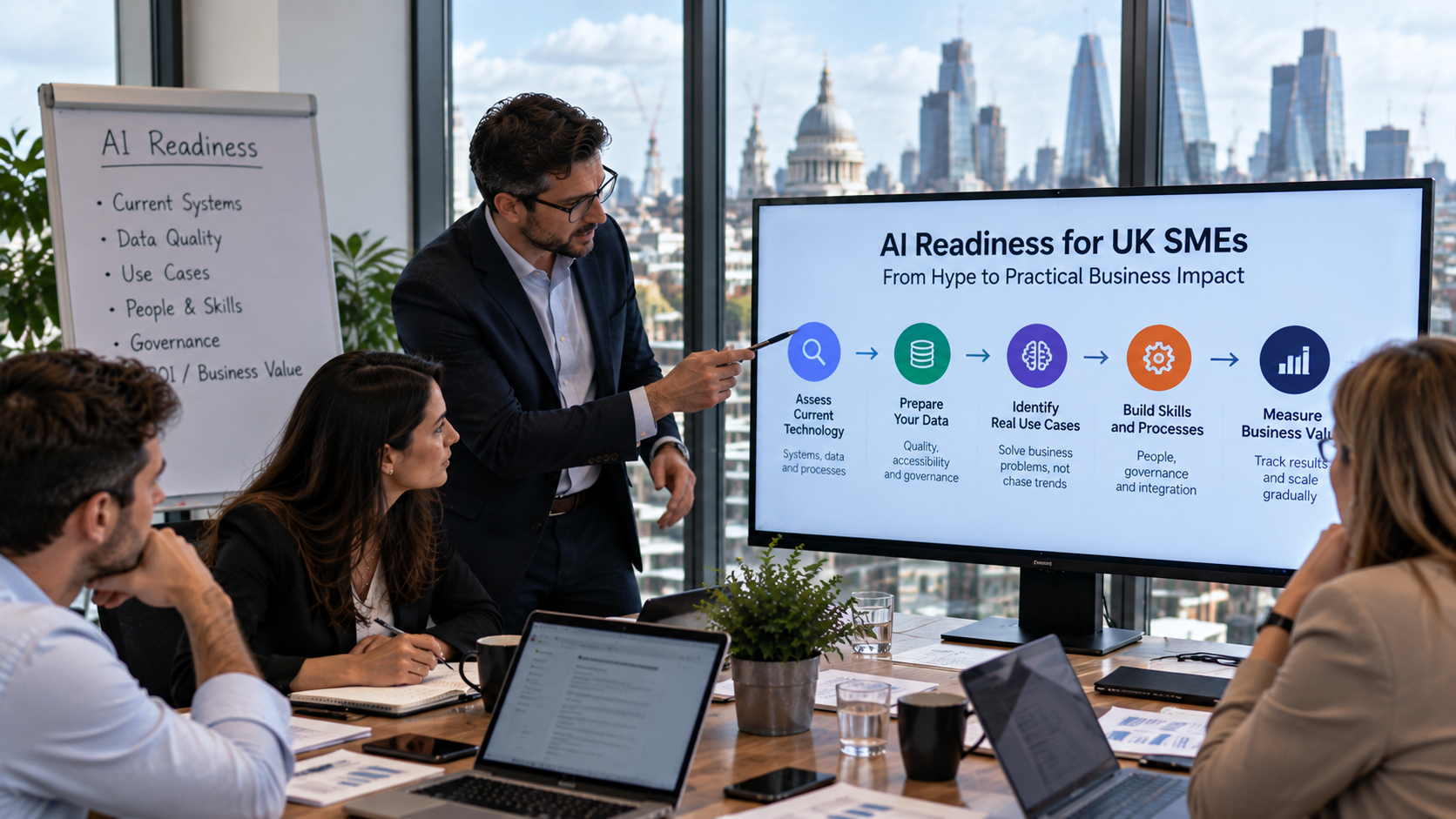
AI readiness starts with business
processes, data, people and governance. Learn a practical framework UK SMEs can
use to identify valuable AI opportunities.
AI has moved quickly from an experimental
technology to a business planning issue. Many UK SMEs are asking how they can
use AI to improve productivity, customer service or decision-making. Yet the
biggest challenge is often not access to AI. It is deciding where AI belongs in
the business and how to introduce it safely.
A useful AI readiness
assessment starts with business goals. A company should be able to explain what
it wants to improve before selecting a model or application. The objective
might be to reduce response time, improve lead qualification, summarise
documents, forecast demand or reduce repetitive administration. Without a clear
outcome, an AI project can become a technology experiment with no measurable
business case. For further context, see Nexteck technology audits.
Processes are the next consideration. AI
works best when the surrounding workflow is understood. If a customer enquiry
passes through several undocumented steps, automating one part may simply move
the bottleneck somewhere else. Process
mapping can identify where AI can support a decision, prepare
information or complete a repetitive step while keeping appropriate human
oversight.
Data quality is equally important. AI
outputs depend heavily on the information available to the system. Businesses
should understand what data they hold, where it comes from, who can access it
and whether it is accurate enough for the intended use. Data that is duplicated
or inconsistent may need to be cleaned or reorganised before it can support
reliable AI workflows.
Privacy and governance cannot be left until
after deployment. Businesses handling personal information should consider UK GDPR
requirements and the principles of data protection from the beginning. The ICO
specifically recommends data protection by design and by default, which means
privacy and security should be considered throughout the lifecycle of a system.
AI opportunities can then be scored.
Nexteck’s published approach describes an AI and IT opportunity log where
processes are considered through impact and urgency, with costs and sequencing
attached. This creates a practical way to distinguish a useful automation from
an interesting experiment. A high-volume, low-risk task may be a better first
project than a complex AI initiative with unclear benefits. For further
context, see ICO data protection principles.
People remain part of the system. Employees
need to understand what an AI tool does, what it does not do and when a human
should review its output. Clear operating procedures help prevent staff from
treating generated information as automatically correct. Training and
governance therefore become part of AI
implementation rather than optional extras. For further context, see
ICO data protection by design.
For UK SMEs, AI readiness is ultimately
about discipline. The winners are unlikely to be the businesses that buy the
most AI tools. They are more likely to be the businesses that identify
meaningful problems, prepare their data, protect customers and staff, measure
outcomes and scale only what works. A structured audit can provide
the roadmap for doing exactly that.