Business Continuity Planning for UK SMEs: Is Your Technology Ready for Disruption?
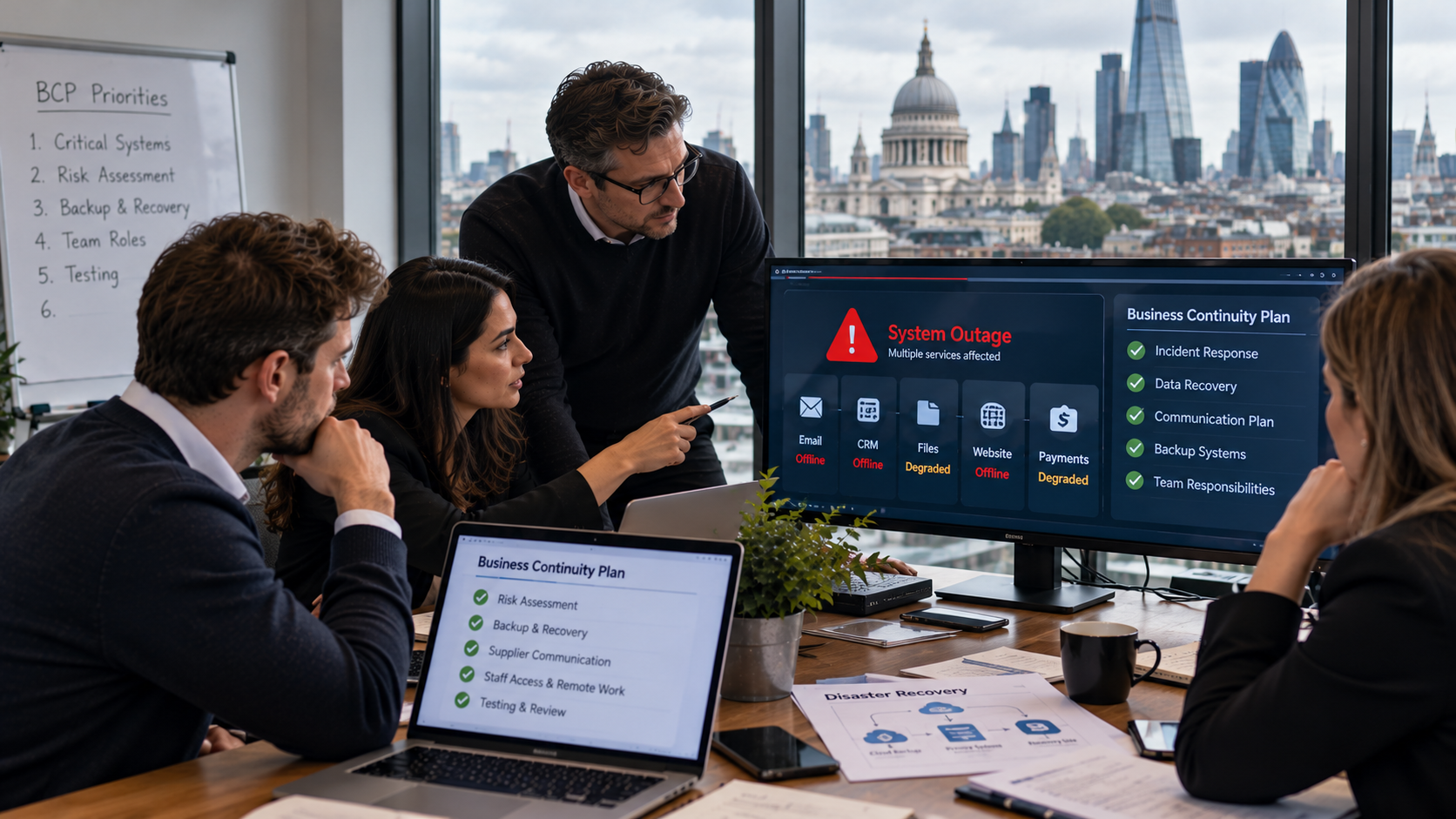
Business Continuity Planning for UK SMEs | The Nexteck
Meta Description: Protect your business from IT downtime. Learn how SMEs in London, Hounslow and West London can plan backups, recovery, supplier resilience and business continuity.
Business continuity planning UK SMEs
IT disaster recovery UK, business continuity services London, technology resilience UK, IT recovery planning, cyber incident recovery, backup strategy for SMEs, business continuity plan Hounslow, IT risk assessment West London, disaster recovery planning England, SME technology consulting UK.
Business Continuity Planning for UK SMEs: Is Your Technology Ready for Disruption?
Introduction: What Happens When Your Business Technology Stops Working?
Imagine opening your office in London on a Monday morning and discovering that your customer management system is unavailable. Employees cannot access customer records, invoices cannot be processed, orders are delayed and customers are waiting for answers.
The problem could be a cyber incident, an accidental deletion, a cloud service outage, a failed software update or a connectivity issue. Whatever the cause, the business faces the same urgent question: how can essential operations continue while the technology is unavailable?
For small and medium-sized businesses, technology disruption can quickly become a commercial problem. Revenue may be delayed, employees lose productive time, customer confidence can suffer and management must make decisions without reliable information.
This is why business continuity planning for UK SMEs deserves attention before an incident occurs.
The National Cyber Security Centre's guidance for small businesses on response and recovery explains how organisations can prepare for incidents and plan their recovery. London businesses can also use the London Resilience Partnership's business emergency guidance to begin thinking about emergency preparation and business continuity.
For companies in London, Hounslow, West London and across the United Kingdom, a practical plan should connect technology recovery with the business services that matter most.
1. Identify the Business Services You Cannot Afford to Lose
The first step in IT continuity planning is understanding which activities are essential to keeping the business operating.
A professional services company may depend on email, document management, client records and invoicing. A distributor may rely on stock systems, order processing and supplier communications. An online retailer may need its website, payment gateway, product database and fulfilment operations.
Create an inventory of critical business services and the systems that support them.
For each service, establish:
What would happen if the service stopped?
How many customers and employees would be affected?
How long could the business operate without it?
Is there a safe manual workaround?
Which systems and suppliers does the service depend on?
Who is responsible for restoring it?
This exercise helps management prioritise recovery. Not every application requires the same level of protection, and not every system needs to be restored at the same time.
2. Understand the Risks That Could Interrupt Your Operations
A useful business continuity plan should be based on credible scenarios rather than a generic list of disasters.
For an SME in Hounslow or West London, possible scenarios include an internet outage, inaccessible office premises, a cyberattack, a cloud application failure, the loss of a key supplier or accidental deletion of important data.
Consider both the likelihood of each scenario and the consequences if it occurs.
A simple risk register can record the event, affected business services, current safeguards, potential impact and actions needed to improve resilience.
For example, if the business relies on a single online accounting platform, management should understand how it would access essential financial information during a prolonged outage. If order processing depends on one integration, the business should identify what happens when that connection fails.
Risk assessment should be reviewed whenever the organisation adopts a major new system, changes suppliers or expands into another location.
3. Do Not Assume Cloud Software Automatically Protects Your Business
Cloud technology can provide flexibility, remote access and reduced infrastructure management. However, using cloud software does not automatically guarantee that all business information can be restored after an incident.
Businesses should understand which services the provider protects, what remains the customer's responsibility and whether independent backups are required.
A deleted file, compromised account or corrupted database may create problems even when the underlying cloud platform remains operational.
The NCSC's guidance on preparing technical recovery capability recommends maintaining tested backups, planning restoration processes and documenting infrastructure dependencies.
A suitable backup strategy should consider:
Customer and supplier records.
Financial data and invoicing information.
Business documents and operational procedures.
Product, stock and order information.
Website content and critical configuration.
Application settings and technical documentation.
Backups should be protected against unauthorised changes and deletion. Where appropriate, businesses should maintain copies separated from their primary systems and test whether those copies can actually be restored.
4. Define Recovery Time and Recovery Point Objectives
A continuity plan becomes more useful when it defines how quickly critical services must return and how much data loss is acceptable.
Recovery Time Objective (RTO) is the target time for restoring a service after disruption.
Recovery Point Objective (RPO) is the maximum acceptable period of data loss, measured backwards from the disruption.
Consider a hypothetical e-commerce business operating across London and the wider UK. Its payment and order-processing services may need to return quickly because downtime directly affects sales. A non-essential reporting application may be able to remain unavailable for longer.
A system processing transactions continuously may also need more frequent recovery points than a system containing information that changes infrequently.
These objectives should reflect business requirements, realistic technical capabilities and the available budget. Setting an ambitious target without testing the recovery process does not make the business resilient.
5. Prepare an Incident Response and Communication Plan
During a technology incident, confusion can delay recovery. Employees may not know who should make decisions, which supplier to contact or whether they should continue processing orders manually.
A clear incident response plan should establish responsibilities before disruption occurs.
Identify:
The incident coordinator.
The technical lead responsible for investigation and restoration.
The business decision-maker responsible for operational priorities.
Supplier contacts and escalation routes.
The person responsible for employee and customer communications.
The process for recording decisions and tracking recovery progress.
Store essential contact information and recovery instructions somewhere accessible if the normal IT environment becomes unavailable.
The NCSC's business continuity preparation guidance emphasises identifying critical services, planning workarounds and testing recovery arrangements.
If an incident involves personal data, regulated activities or legal reporting obligations, the business should follow the applicable requirements and seek qualified advice where necessary.
6. Test Backups and Recovery Procedures Before You Need Them
A backup that has never been restored is an untested assumption, not proven recovery capability.
Files may be incomplete, passwords may be unavailable, documentation may be outdated and the time needed to restore an application may be longer than expected.
A practical recovery test should include the following steps:
Select a business-critical application or data set.
Confirm that a suitable backup exists.
Restore the information in a controlled environment.
Verify that the restored data is complete and usable.
Record the time taken and any problems encountered.
Update the recovery procedure and assign follow-up actions.
Testing should reflect the importance of the system and the consequences of failure.
The NCSC's guidance on ransomware-resistant backups explains why backups need protection against destructive attacks. A business should not assume that a backup is safe merely because it exists.
Recovery testing can reveal missing credentials, undocumented dependencies and weaknesses in the restoration process before a real incident makes them urgent.
7. Prepare for Supplier and Third-Party Disruption
Many UK SMEs depend on external suppliers for cloud hosting, payment processing, accounting, communications, customer management and IT support.
A supplier outage can affect operations even when the company's own computers and network are working correctly.
Review critical suppliers and document their support arrangements, escalation contacts, contractual commitments and available data export options.
Consider what would happen if a supplier became unavailable for several hours, several days or longer. Would employees have a safe temporary workaround? Could customers still be served? Could essential records be accessed through another approved method?
Where the business depends on a single provider, evaluate the impact and cost of additional resilience. A second system is not always necessary, but the consequences of a single point of failure should be understood.
8. Build a Practical 30-Day Business Continuity Improvement Plan
Business continuity planning does not have to begin with a large transformation project. SMEs can start by identifying the most important gaps and addressing them in a structured way.
| Timeline | Recommended activity | Intended result |
|---|---|---|
| Days 1–7 | Identify critical services, systems and suppliers | Clear understanding of dependencies |
| Days 8–14 | Review backups, access controls and recovery needs | Prioritised list of risks |
| Days 15–21 | Document incident roles, contacts and workarounds | Clearer response responsibilities |
| Days 22–30 | Test a recovery scenario and record lessons learned | Evidence of recovery capability and remaining gaps |
This is an initial improvement plan, not a guarantee that every risk will be resolved within a month. Complex systems may require specialist testing, contract changes or longer-term investment.
Assign an owner to every important action and review progress with management. Business continuity should remain part of normal operations rather than being forgotten after the first assessment.
9. Connect Business Continuity with Your Technology Strategy
Business continuity is not limited to emergency response. It is also influenced by everyday technology decisions.
Clear system ownership, documented integrations, sensible supplier arrangements, reliable data and tested recovery processes can make an organisation easier to manage when disruption occurs.
For SMEs in London, Hounslow, West London and across England, a structured technology strategy can help leadership teams understand where resilience improvements should be prioritised.
The Nexteck helps businesses explore technology strategy, system architecture and operational improvement. A business-focused assessment can help identify dependencies, clarify priorities and connect technology investment with the company's operational objectives.
Visit The Nexteck to explore how technology planning can support your business objectives.
10. Business Continuity Planning for London, Hounslow and West London SMEs
Local businesses may have different continuity requirements depending on their industry, premises, customers and supply chains.
A logistics company serving West London may prioritise warehouse systems, stock records and delivery coordination. A professional services business in Central London may depend on client documents, secure communications and access to specialist applications. A retailer in Hounslow may need its payment systems and online orders to keep operating.
A useful business continuity plan reflects these differences rather than copying a generic template.
It should be proportionate to the organisation's size, risk exposure and resources. Smaller businesses can make meaningful progress by identifying critical services, protecting important information, documenting responsibilities and rehearsing recovery procedures.
The most effective plan is one that employees can understand and use when normal operations are disrupted.
Conclusion: Make Technology Resilience a Business Priority
Technology disruption can affect customer service, revenue, employee productivity and business confidence. UK SMEs cannot prevent every incident, but they can prepare to respond more effectively.
Start by identifying essential business services, documenting dependencies, defining recovery objectives, protecting backups, preparing communication procedures and testing restoration processes. Review supplier risks and update the plan whenever the business or its technology changes.
Whether your company operates in London, Hounslow, West London or elsewhere in the United Kingdom, business continuity planning can help you make more informed decisions about technology resilience.
Is your business prepared for unexpected technology disruption? Visit The Nexteck to explore technology strategy and discuss the priorities that matter to your business.
This article provides general information, not a guarantee of resilience or a substitute for specialist cybersecurity, legal or regulatory advice. Recovery plans should be tailored to each organisation.